Timely ISF 10+2 compliance can speed cargo release by up to 50%, cutting costly delays for importers. ISF 10+2 is a U.S. Customs and Border Protection mandate requiring importers and carriers to submit specific cargo data before goods arrive. Missing deadlines triggers fines, shipment holds, and customs scrutiny. This guide breaks down the 10 importer and 2 carrier data elements, filing deadlines, penalties, and practical compliance steps to keep your international shipments moving smoothly.
Table of Contents
- Introduction To ISF 10+2
- Breakdown Of ISF 10 Data Elements
- Additional 2 Carrier Data Elements
- ISF 10+2 Filing Procedures And Deadlines
- Enforcement, Penalties, And Common Compliance Pitfalls
- Practical Steps For ISF 10+2 Compliance
- Common Misconceptions About ISF 10+2
- Summary And Compliance Takeaways
- Simplify ISF 10+2 Compliance With Worldwide Express
- Frequently Asked Questions About ISF 10+2
Key takeaways
| Point | Details |
|---|---|
| ISF 10+2 requires 10 importer data elements and 2 carrier data elements submitted before vessel loading. | Importers provide manufacturer details, buyer info, and shipment specifics while carriers submit stow plans and container status. |
| Filing deadline is 24 hours before cargo loads at the foreign port. | Late submissions result in fines up to $5,000 per violation and delayed cargo release. |
| Accurate data submission reduces customs delays by targeting high-risk shipments efficiently. | Precise information helps CBP identify security threats without holding compliant cargo. |
| Common mistakes include incomplete data, missed deadlines, and mismatched Bill of Lading details. | Errors trigger inspections, storage fees, and supply chain disruptions. |
| Automation and customs brokers improve filing accuracy and on-time compliance. | Technology reduces manual errors by over 40% and ensures consistent deadline adherence. |
Introduction to ISF 10+2
ISF 10+2 is mandated under the Maritime Transportation Security Act to enhance cargo security and trade data accuracy. This dual data submission requirement means importers file 10 specific elements and carriers submit 2 additional elements before ocean cargo reaches U.S. ports. The program helps CBP conduct risk assessments early, targeting suspicious shipments while expediting compliant cargo through customs.
Why does ISF 10+2 matter for your business? It directly impacts cargo clearance speed, compliance costs, and supply chain predictability. Proper filing reduces the chance of customs holds that disrupt delivery schedules and inflate storage fees. Non-compliance brings financial penalties and reputational damage with CBP.
The ISF 10+2 definition and role clarifies distinct responsibilities. Importers must gather and transmit detailed shipment information from manufacturers, buyers, and shippers. Carriers independently file vessel stow plans and container status messages. Both parties work in parallel to provide CBP with comprehensive cargo visibility before vessels depart foreign ports.
Key responsibilities include:
- Importers collect and submit 10 data elements covering manufacturer identity, consignee details, and cargo descriptions
- Carriers provide 2 elements detailing container positions and movements aboard vessels
- Both parties ensure electronic filing occurs at least 24 hours before loading at origin ports
- CBP uses combined data to assess security risks and allocate inspection resources efficiently
This legal requirement is not negotiable. Understanding your role prevents expensive compliance failures and keeps international shipments on schedule.
Breakdown of ISF 10 data elements
Importers must submit 10 detailed data elements accurately for CBP risk assessment and shipment clearance. Each element serves a specific purpose in identifying cargo origins, ownership, and routing. Missing or incorrect information triggers penalties and delays.

The ISF 10 data element checklist includes manufacturer name and address, seller name and address, buyer name and address, ship to name and address, container stuffing location, consolidator name and address, importer of record number, consignee number, country of origin, and commodity Harmonized Tariff Schedule number. These elements paint a complete picture of your supply chain for CBP analysts.
Why does each element matter? Manufacturer details help trace production sources and identify counterfeit risks. Buyer and consignee information verifies legitimate trade relationships. Container stuffing locations reveal where cargo was packed, crucial for detecting tampered shipments. Commodity codes enable duty calculations and compliance checks against trade restrictions.
Typical data sources include:
- Purchase orders and commercial invoices for buyer and seller details
- Bills of lading and packing lists for container stuffing locations
- Supplier contracts for manufacturer names and addresses
- Internal records for importer of record and consignee numbers
- Product specifications for Harmonized Tariff Schedule classifications
| Data Element | Description | Source Document |
|---|---|---|
| Manufacturer | Name and address of goods producer | Commercial invoice, supplier contract |
| Seller | Entity selling goods to U.S. buyer | Purchase order, invoice |
| Buyer | U.S. entity purchasing goods | Internal records, purchase order |
| Ship To | Final delivery destination in U.S. | Bill of lading, shipping instructions |
| Container Stuffing Location | Where cargo was loaded into container | Packing list, booking confirmation |
| Consolidator | Party consolidating shipments if applicable | Freight forwarder documents |
| Importer of Record Number | IRS or CBP assigned number | Internal compliance records |
| Consignee Number | Identification for receiving party | Internal or CBP records |
| Country of Origin | Where goods were manufactured | Certificate of origin, invoice |
| HTS Number | 6-digit commodity classification code | Product specifications, tariff guide |
Accuracy is non-negotiable. CBP cross-references ISF data with entry documentation and bills of lading. Discrepancies lead to intensive examinations and potential fines. Gathering precise information from supply chain partners before filing prevents costly corrections.
Additional 2 carrier data elements
Carriers submit Vessel Stow Plan and Container Status Messages as part of ISF 10+2 to supplement importer data. These elements provide CBP with real-time visibility into container locations and movements aboard vessels. Unlike importer filings, carriers control these submissions directly through vessel operations.
The Vessel Stow Plan details exactly where each container sits on the ship. This information helps CBP identify which containers to inspect upon arrival without unloading entire vessels. Container Status Messages update CBP on container movements, including loading, discharge, and any changes during transit.
Why do these carrier elements matter? They complete the cargo security picture by confirming physical container positions match declared cargo. CBP uses stow plans to prioritize high-risk containers for inspection while clearing low-risk shipments quickly. Status messages alert authorities to unexpected container movements that might indicate tampering or smuggling.
Carrier responsibilities in ISF 10+2 require timely electronic transmission through approved systems. Carriers typically file stow plans within 48 hours after vessel departure from the foreign port. Container status messages transmit automatically as cargo handling events occur.
Collaboration between importers and carriers ensures complete compliance. Key coordination points include:
- Importers confirm carriers have correct booking numbers and container details
- Carriers verify vessel schedules align with importer filing deadlines
- Both parties monitor acknowledgment receipts from CBP for successful submissions
- Communication channels stay open to resolve data mismatches before vessel arrival
When carriers file accurately and punctually, your cargo benefits from smoother port entry. Delays in carrier submissions can hold up entire shipments even if importer filings are perfect. Building relationships with reliable carriers who prioritize ISF compliance protects your supply chain from avoidable disruptions.
ISF 10+2 filing procedures and deadlines
ISF 10+2 filings must be submitted electronically at least 24 hours before vessel loading at the foreign port. This strict deadline gives CBP time to conduct risk analysis and issue targeting instructions before cargo departs. The 24-hour rule is firm and applies regardless of shipment size or value.
Electronic filing occurs through CBP-approved Automated Broker Interface systems or Automated Manifest System platforms. Most importers work with licensed customs brokers who handle electronic transmissions using specialized software. These systems generate confirmation receipts proving successful submission and acceptance by CBP.
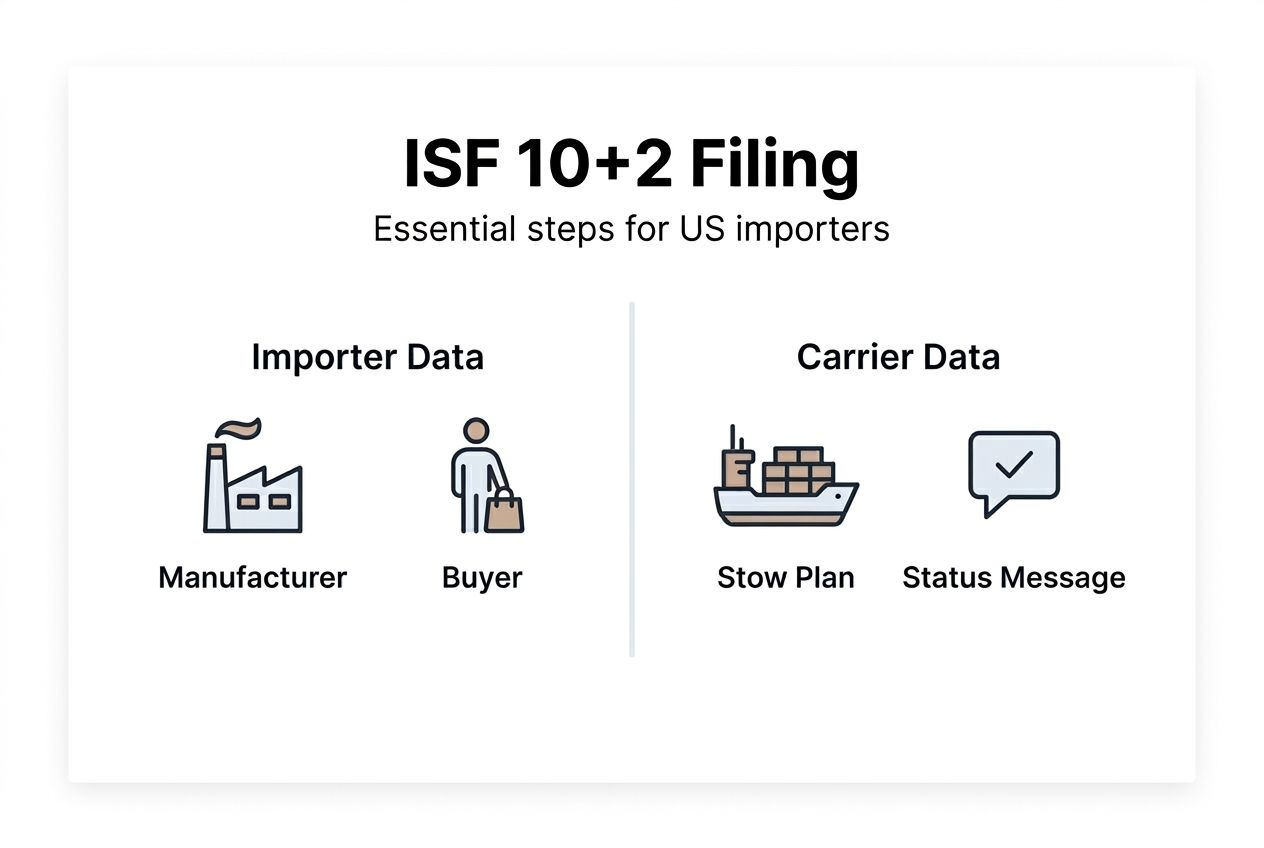
Who files what? Importers or their authorized agents file the 10 importer data elements. Ocean carriers or their agents separately file the 2 carrier elements. You cannot combine these filings into one submission because different parties control different data.
Follow these ISF 10+2 filing steps and tips for timely compliance:
- Gather all 10 required data elements from suppliers, freight forwarders, and internal records at least 48 hours before the filing deadline
- Verify data accuracy by cross-checking against purchase orders, invoices, and bills of lading
- Submit electronic filing through your customs broker or approved software system
- Monitor for CBP acknowledgment receipt confirming acceptance within hours of submission
- Coordinate with your carrier to ensure they file their 2 elements on time
- Store confirmation receipts and filing records for audit purposes
Pro Tip: Set internal deadlines 48 hours before the legal 24-hour requirement to allow time for corrections if CBP rejects initial submissions due to data errors or formatting issues.
Automation tools can track multiple shipments simultaneously and send alerts as deadlines approach. Many customs brokers offer dashboard systems showing filing status in real time. These technologies reduce human error and ensure no shipments slip through without proper filings.
Enforcement, penalties, and common compliance pitfalls
Failing to file ISF 10+2 on time can result in fines up to $5,000 and delayed or seized shipments. CBP enforces these penalties consistently to maintain cargo security program integrity. Even first-time violators face full fines with no grace periods.
Common compliance challenges with ISF 10+2 include:
- Late filing caused by miscalculating the 24-hour deadline or waiting for complete documentation
- Incorrect manufacturer addresses due to incomplete supplier information
- Mismatched data between ISF filings and bills of lading triggering CBP audits
- Missing commodity codes or wrong Harmonized Tariff Schedule classifications
- Failure to update filings when shipment details change after initial submission
What happens when you violate ISF requirements? CBP issues “do not load” orders preventing cargo from boarding vessels. Shipments already at sea face intensive examinations upon arrival, causing multi-day delays. Repeat violations trigger Focused Assessments where CBP audits your entire import program.
“CBP has collected millions in ISF penalties since 2026, with late filings and inaccurate data representing over 70% of violations. Importers who treat ISF as an afterthought pay the price in fines and supply chain disruptions.”
The impact extends beyond immediate fines. Delayed cargo generates demurrage charges at ports, storage fees at warehouses, and missed delivery commitments to customers. Your reputation with CBP suffers, potentially leading to increased inspection rates on future shipments.
Misconceptions that lead to violations:
- Believing small shipments are exempt from ISF requirements when all ocean cargo must comply
- Assuming approximate data is acceptable when CBP demands precise, verifiable information
- Thinking filing deadlines are flexible based on vessel schedules when the 24-hour rule is absolute
- Expecting customs brokers to obtain all data elements when importers control supplier information
Preventing these pitfalls requires treating ISF 10+2 as a critical supply chain milestone, not administrative paperwork. Build filing procedures into your purchasing and logistics workflows to ensure consistent compliance.
Practical steps for ISF 10+2 compliance
Automating electronic ISF submissions reduces errors by over 40% and improves on-time filing consistently. Technology platforms integrate with your order management systems to pull data automatically, eliminating manual entry mistakes. Cloud-based solutions provide visibility across multiple shipments and generate compliance reports for audit trails.
Strategies for achieving reliable ISF 10+2 compliance best practices:
- Partner with experienced customs brokers who specialize in ISF filings and maintain direct connections to CBP systems
- Establish data collection protocols with overseas suppliers requiring them to provide accurate manufacturer and origin details with every order
- Implement internal checklists verifying all 10 data elements are complete before authorizing filing
- Schedule regular training for purchasing and logistics staff on ISF requirements and common errors
- Monitor CBP acknowledgment receipts immediately after filing to catch rejections while time remains for corrections
Coordination between importers and carriers prevents gaps in the ISF 10+2 filing process. Confirm your carrier understands their obligation to file vessel stow plans and container status messages. Request confirmation numbers from carriers proving they submitted their elements on time. Misunderstandings about who files what cause unnecessary compliance failures.
A comprehensive compliance checklist guide helps structure your ISF program. Include steps for data validation, electronic transmission, receipt verification, and record retention. Assign specific team members responsibility for each checklist item to ensure accountability.
Pro Tip: Conduct quarterly audits of your ISF filing records comparing submitted data against final entry documents to identify recurring data quality issues before CBP notices patterns.
Consistent compliance delivers business benefits beyond avoiding fines. Cargo moves through customs faster, reducing transit times and improving customer satisfaction. Your standing with CBP improves, potentially qualifying you for trusted trader programs offering further facilitation benefits.
Common misconceptions about ISF 10+2
CBP requires ISF 10+2 filings at least 24 hours before vessel loading; post-arrival filings are not accepted. One widespread myth suggests you can file after cargo ships or even after it arrives at U.S. ports. This misunderstanding leads to automatic violations and penalties because the security screening purpose requires advance information.
Frequent ISF 10+2 myth clarifications include:
- Myth: Small importers or low-value shipments are exempt from ISF requirements. Reality: All ocean cargo entering the U.S. requires ISF filing regardless of value or importer size.
- Myth: Customs brokers automatically have all data needed to file ISF. Reality: Importers must provide supplier details, manufacturer information, and commodity codes that brokers cannot access independently.
- Myth: Approximate or incomplete data is acceptable for initial filing with updates later. Reality: CBP expects accurate, complete information at filing time and treats incomplete submissions as violations.
- Myth: Only the importer needs to file ISF, carriers handle everything automatically. Reality: Both importers and carriers have independent filing obligations that must be coordinated.
- Myth: Once filed, ISF data never needs updating even if shipment details change. Reality: Material changes require amended filings to maintain accuracy.
Why do these misconceptions persist? ISF 10+2 launched in 2009 but many importers still confuse it with entry filing requirements that occur after cargo arrival. The different timelines and data elements create confusion about what information goes where and when.
Another common mistake involves believing freight forwarders will handle ISF filings without explicit authorization and data provision. While forwarders can submit filings as your agent, they need complete information from you. Assuming they have details about your manufacturers or commodity classifications leads to rushed, error-prone submissions.
Some importers think paying for goods makes the supplier responsible for ISF compliance. In reality, the importer of record always bears legal responsibility for timely, accurate filing. You can authorize brokers or forwarders to file on your behalf, but the liability stays with you.
Clearing up these misconceptions prevents compliance failures. Treat ISF 10+2 as a mandatory supply chain milestone requiring dedicated resources, clear procedures, and proactive data management.
Summary and compliance takeaways
ISF 10+2 compliance directly determines whether your international shipments clear customs smoothly or face costly delays and penalties. The 24-hour pre-loading deadline is absolute, requiring advance preparation and coordination with suppliers and carriers. Understanding the distinct roles of importers filing 10 data elements and carriers submitting 2 additional elements prevents gaps in compliance.
Core compliance takeaways:
- Accurate data submission from verified sources reduces customs targeting and inspection rates
- Electronic filing systems and customs broker partnerships minimize errors and ensure deadline adherence
- Coordination between importers and carriers guarantees complete ISF 10+2 filings without missing elements
- Treating ISF as a critical supply chain function rather than paperwork prevents violations
- Investment in compliance technology and training pays returns through faster cargo clearance and avoided fines
The business case for ISF 10+2 excellence extends beyond avoiding $5,000 penalties. Compliant importers experience fewer shipment holds, lower storage costs, and improved delivery predictability. Your reputation with CBP as a low-risk trader opens doors to facilitation programs and reduced scrutiny.
Starting your next import? Build ISF filing into your purchase order process from day one. Establish data collection protocols with suppliers requiring them to provide complete manufacturer and origin information. Partner with customs brokers who demonstrate consistent ISF expertise and maintain robust electronic filing systems.
Simplify ISF 10+2 compliance with Worldwide Express
Navigating ISF 10+2 requirements becomes straightforward when you partner with experienced freight forwarding and customs brokerage professionals. Worldwide Express specializes in managing complex compliance requirements while keeping your cargo moving efficiently through U.S. ports.
Our customs brokerage team handles ISF 10+2 filings with precision, gathering required data elements and submitting electronic filings well ahead of deadlines. We coordinate with carriers to ensure complete submissions covering all 10 importer and 2 carrier elements. Real-time tracking systems provide visibility into filing status and CBP acknowledgments.
Explore comprehensive best freight forwarding services designed specifically for import compliance. Our U.S. customs brokerage solutions integrate ISF management with entry filing, duty calculation, and post-clearance support. Learn how to choose a freight forwarder that prioritizes compliance alongside competitive rates and reliable service.
Frequently asked questions about ISF 10+2
What happens if ISF 10+2 is filed late?
CBP issues fines up to $5,000 per violation for late ISF filings. Your cargo may receive a “do not load” order preventing shipment, or face intensive examination upon arrival causing multi-day delays and storage charges.
Who exactly must file the 10 and 2 data elements?
Importers or their authorized agents file the 10 importer data elements covering manufacturer, buyer, consignee, and cargo details. Ocean carriers or their agents independently file the 2 carrier elements including vessel stow plans and container status messages.
Can small importers handle ISF 10+2 without brokers?
Yes, if you have CBP-approved electronic filing system access and can gather accurate data from suppliers consistently. However, most small importers find licensed customs brokers cost-effective because they provide filing expertise, system access, and liability protection.
How can I confirm my ISF 10+2 submission was accepted?
CBP sends electronic acknowledgment receipts through the Automated Broker Interface or Automated Manifest System within hours of submission. Your customs broker should provide copies of these receipts confirming successful filing and acceptance.
Are there penalties for inaccurate ISF data even if filed on time?
Absolutely. CBP compares ISF data against entry documents and bills of lading. Material inaccuracies trigger the same $5,000 penalties as late filings, plus potential cargo examinations and increased scrutiny on future shipments.
Recommended
- Complete isf 10 2 form for compliant U.S. imports – Worldwide Express, Inc.
- What Is ISF and Its Role in U.S. Import Compliance – Worldwide Express, Inc.
- How to Complete the ISF 10 2 Form PDF for Compliance – Worldwide Express, Inc.
- ISF Bond Requirements – Safeguarding U.S. Imports – Worldwide Express, Inc.