More than 60 percent of American manufacturers say sustainability is now a core priority, yet cost pressures and evolving regulations make improvement challenging. Supply chain managers face mounting expectations to cut emissions, reduce waste, and maintain efficient logistics. This resource uncovers the defining elements of sustainable supply chain practices, showing how American manufacturing leaders can achieve both environmental compliance and meaningful cost savings.
Table of Contents
- Defining Sustainable Supply Chain Practices
- Types Of Environmentally Friendly Logistics Strategies
- Key Features Of Green Sourcing And Transportation
- Navigating U.S. Regulations And Compliance
- Roles And Responsibilities For Manufacturers
- Risks, Costs, And Common Sustainability Challenges
Key Takeaways
| Point | Details |
|---|---|
| Sustainable Supply Chain Focus | Emphasize holistic impact management by integrating environmental, economic, and social considerations into supply chain practices. |
| Green Logistics Implementation | Adopt environmentally friendly logistics strategies to minimize energy use, waste, and enhance transportation efficiency. |
| Compliance with Regulations | Navigate complex U.S. regulatory frameworks by establishing robust compliance programs focused on environmental standards and ethical sourcing. |
| Addressing Sustainability Challenges | Develop strategic approaches to manage financial, technological, and cultural challenges associated with sustainable supply chain transformation. |
Defining sustainable supply chain practices
Sustainable supply chain practices represent a strategic approach that goes beyond traditional operational efficiency, integrating environmental and social responsibility into every stage of product development and logistics. Unlike conventional supply chain models focused purely on cost reduction and speed, these practices prioritize holistic impact management.
At its core, sustainable supply chain management involves systematically addressing three critical dimensions: environmental protection, economic performance, and social responsibility. Manufacturers must evaluate their entire ecosystem, from raw material sourcing to final product delivery, considering factors like carbon emissions, worker conditions, resource consumption, and long-term ecological impact. This comprehensive approach transforms supply chains from linear consumption models into circular systems that minimize waste and maximize value.
Key characteristics of sustainable supply chain practices include strategic supplier selection, transparent reporting, waste reduction, energy efficiency, and commitment to ethical labor standards. Manufacturers implementing these practices typically focus on:
The following table provides a quick comparison of traditional supply chains versus sustainable supply chains across major business dimensions:
| Dimension | Traditional Supply Chain | Sustainable Supply Chain |
|---|---|---|
| Focus | Cost efficiency | Holistic impact management |
| Resource Use | High consumption | Optimized, circular flows |
| Labor Practices | Minimal oversight | Ethical, transparent |
| Environmental Impact | Often overlooked | Continuously tracked |
| Supplier Selection | Price-driven | Sustainability-driven |
| Reporting | Limited transparency | Full disclosures |
- Reducing greenhouse gas emissions
- Minimizing material waste
- Implementing renewable energy solutions
- Ensuring fair labor practices
- Creating closed-loop production systems
- Developing transparent sourcing protocols
Pro tip: Start by conducting a comprehensive sustainability audit of your current supply chain to identify immediate improvement opportunities and establish baseline metrics for future progress.
Types of environmentally friendly logistics strategies
Green logistics has emerged as a critical approach for manufacturers seeking to reduce their environmental footprint while maintaining operational efficiency. Comprehensive green logistics strategies encompass a wide range of innovative techniques designed to minimize energy consumption, reduce waste, and optimize transportation resources.

Manufacturers can implement several key environmentally friendly logistics strategies to transform their supply chain operations. These strategies focus on multiple dimensions, including transportation efficiency, packaging optimization, waste reduction, and technological innovation. Specifically, companies can adopt approaches such as using alternative fuel vehicles, implementing advanced route optimization software, redesigning packaging to reduce material consumption, and leveraging digital technologies to minimize unnecessary transportation.
Critical environmentally friendly logistics strategies include:
- Alternative Fuel Vehicles: Transitioning to electric, hybrid, or hydrogen-powered transportation
- Route Optimization: Using advanced algorithms to minimize fuel consumption and reduce transportation distances
- Packaging Innovation: Developing lightweight, recyclable, and compact packaging materials
- Reverse Logistics: Creating efficient systems for product returns and recycling
- Warehouse Energy Management: Implementing solar power, LED lighting, and energy-efficient equipment
- Digital Tracking: Utilizing real-time monitoring systems to enhance logistical efficiency
Pro tip: Conduct a comprehensive carbon footprint assessment of your current logistics operations to identify the most impactful areas for sustainable transformation and prioritize your green logistics investments.
Key features of green sourcing and transportation
Modern manufacturing requires a comprehensive approach to green sourcing and transportation that goes beyond traditional cost-cutting strategies. Sustainable transportation initiatives have become critical for companies seeking to reduce their environmental impact while maintaining operational efficiency and competitive advantage.
The key features of green sourcing and transportation encompass a holistic strategy that addresses multiple dimensions of supply chain sustainability. This approach involves carefully selecting suppliers with strong environmental credentials, implementing advanced transportation technologies, and developing robust systems that minimize carbon emissions. Manufacturers are increasingly focusing on strategies such as selecting local suppliers to reduce transportation distances, investing in low-emission vehicles, utilizing advanced route optimization software, and developing transparent tracking mechanisms for their entire logistics network.
Critical components of green sourcing and transportation include:
- Sustainable Supplier Selection: Prioritizing vendors with demonstrated environmental commitment
- Carbon Emission Tracking: Implementing comprehensive measurement and reduction strategies
- Alternative Fuel Integration: Transitioning to electric, hybrid, and hydrogen-powered transportation
- Efficient Route Planning: Using advanced algorithms to minimize fuel consumption
- Packaging Optimization: Reducing material waste and developing recyclable shipping materials
- Digital Monitoring: Utilizing real-time tracking to enhance logistical efficiency
Pro tip: Develop a comprehensive sustainability scorecard for your suppliers that evaluates their environmental performance, helping you make more informed sourcing decisions and drive systemic change across your supply chain.
Navigating U.S. regulations and compliance
Supply chain compliance in the United States has become increasingly complex, requiring manufacturers to understand and implement comprehensive regulatory frameworks. Bipartisan legislation and executive initiatives are reshaping how companies approach supply chain management, emphasizing national security, economic resilience, and sustainable practices.
Manufacturers must navigate a multifaceted regulatory landscape that encompasses environmental standards, trade regulations, labor requirements, and national security considerations. This involves developing robust compliance programs that address federal and state-level requirements, including adherence to environmental protection standards, ethical sourcing guidelines, and domestic manufacturing incentives. Companies need to implement comprehensive tracking systems, conduct regular internal audits, and maintain transparent documentation to demonstrate compliance across multiple regulatory domains.
Key areas of focus for U.S. supply chain regulatory compliance include:
- Domestic Manufacturing Requirements: Meeting federal guidelines for American production
- Environmental Compliance: Adhering to EPA and state-level environmental protection standards
- Trade Regulation Adherence: Following Department of Commerce import/export guidelines
- Labor and Ethical Sourcing: Ensuring fair labor practices and supply chain transparency
- National Security Protocols: Protecting critical infrastructure and technology supply chains
- Sustainability Reporting: Documenting environmental and social governance metrics
Pro tip: Develop a cross-functional compliance team that includes legal, operations, and sustainability experts to create a comprehensive regulatory monitoring and adaptation strategy.
Roles and responsibilities for manufacturers
Sustainable manufacturing demands a comprehensive approach to supply chain management that extends far beyond traditional production considerations. Manufacturers play a critical role in embedding sustainability throughout their operational ecosystems, requiring strategic leadership and proactive environmental stewardship.
The responsibilities of modern manufacturers encompass a multifaceted approach to sustainable supply chain management. This involves developing robust systems that integrate environmental, social, and economic considerations into every aspect of production and procurement. Manufacturers must now act as strategic orchestrators, carefully managing supplier relationships, implementing circular economy principles, tracking environmental impacts, and driving innovative solutions that reduce carbon footprints while maintaining economic competitiveness.
Key roles and responsibilities for manufacturers include:
- Strategic Sustainability Planning: Developing comprehensive environmental and social governance frameworks
- Supplier Engagement: Evaluating and selecting partners based on sustainability criteria
- Environmental Impact Measurement: Implementing comprehensive carbon tracking and reporting systems
- Circular Economy Integration: Designing products and processes for maximum resource efficiency
- Innovation Leadership: Investing in sustainable technologies and production methods
- Regulatory Compliance: Ensuring adherence to environmental and social responsibility standards
Pro tip: Create a dedicated sustainability leadership position reporting directly to senior management to ensure environmental and social considerations are integrated at the highest strategic levels of your organization.
Risks, costs, and common sustainability challenges
Sustainable supply chain transformation involves navigating a complex landscape of financial, operational, and strategic challenges that can significantly impact manufacturing organizations. Supply chain vulnerabilities create substantial risks that require comprehensive and strategic management approaches to mitigate potential disruptions.
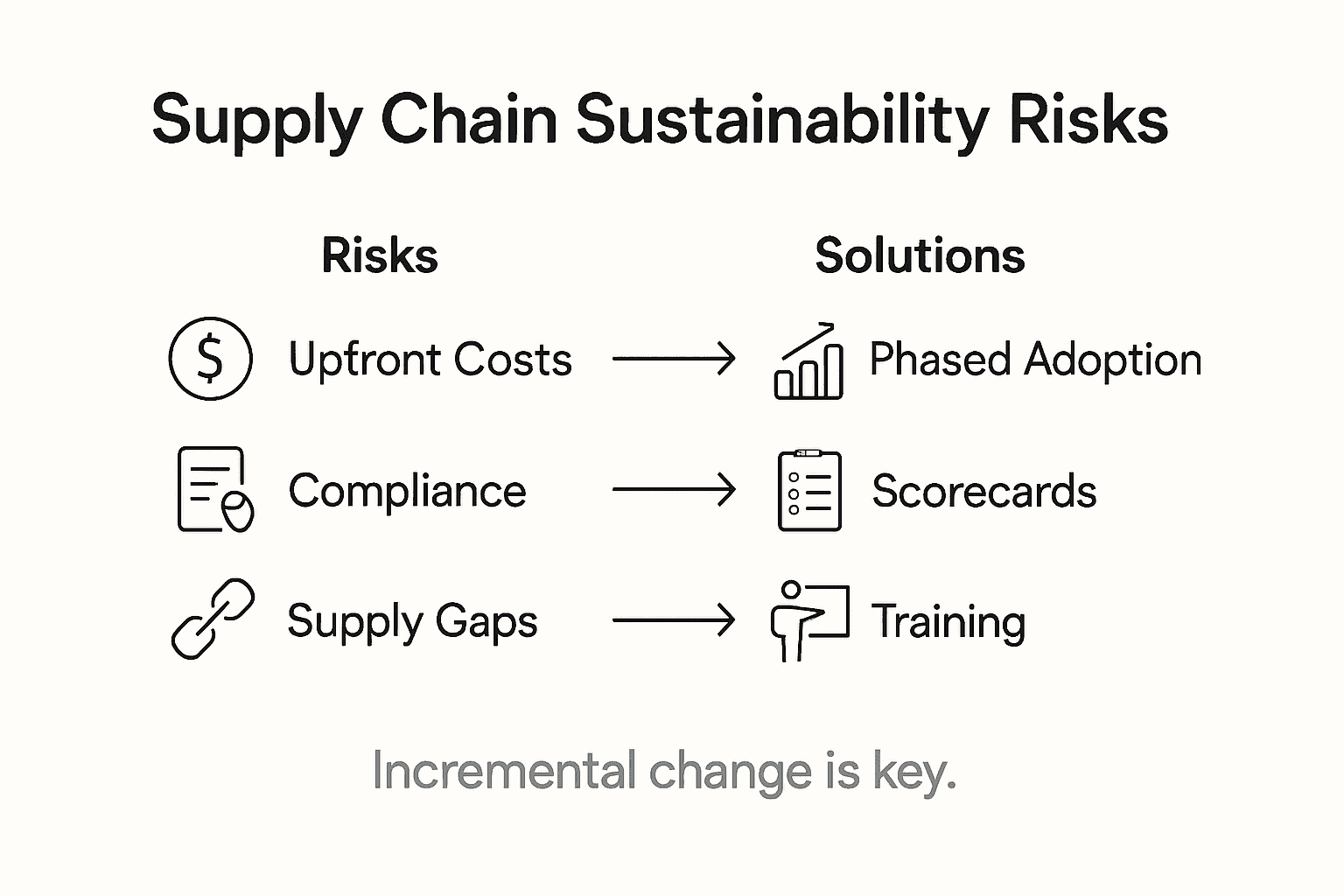
Manufacturers face multifaceted sustainability challenges that extend beyond traditional operational considerations. These include substantial upfront investment costs for new technologies, complex emissions tracking, regulatory compliance expenses, and the need to redesign existing production systems. The financial burden often creates hesitation among companies, with many struggling to balance short-term economic constraints against long-term sustainability goals. Additional challenges emerge from the intricate nature of global supply networks, where transparency and coordinated action become increasingly difficult.
Key sustainability risks and challenges include:
Here is a summary of major sustainability risks, their potential costs, and approaches to manage each challenge:
| Risk/Challenge | Cost Impact | Strategic Mitigation Approach |
|---|---|---|
| Investment Barriers | High upfront expenses | Phased implementation, ROI analysis |
| Technological Complexity | Integration costs | Modular upgrades, staff training |
| Regulatory Uncertainty | Compliance fees | Continuous regulatory monitoring |
| Supply Chain Transparency | Visibility challenges | Tiered supplier audits |
| Performance Measurement | Inconsistent metrics | Standardized tracking tools |
| Cultural Resistance | Slow adoption | Leadership commitment, change campaigns |
- Financial Investment Barriers: High initial costs for sustainable technologies
- Technological Complexity: Integrating advanced emissions tracking systems
- Regulatory Uncertainty: Evolving environmental compliance requirements
- Supply Chain Transparency: Limited visibility across multiple supplier tiers
- Performance Measurement: Developing consistent sustainability metrics
- Cultural Resistance: Overcoming organizational inertia and traditional mindsets
Pro tip: Develop a phased implementation strategy that breaks sustainability investments into manageable increments, allowing for gradual transformation and demonstrating tangible returns at each stage.
Enhance Your Sustainable Supply Chain with Expert Logistics Support
Manufacturers aiming to implement sustainable supply chain practices face complex challenges such as regulatory compliance, emission tracking, and optimizing green sourcing and transportation. These hurdles demand a logistics partner who understands the critical balance between eco-friendly initiatives and operational efficiency. Worldwide Express offers tailored solutions that empower your business to meet these goals through advanced freight forwarding, customs brokerage, and real-time global tracking systems that streamline your supply chain while reducing its environmental footprint.
Take the next step toward transforming your supply chain by partnering with Worldwide Express for trusted logistics expertise. Visit our main website to explore how our integrated services support sustainable manufacturing. Discover customized plans that include import/export freight forwarding and compliance management solutions designed to minimize risk and maximize efficiency. Act now to build a greener, more resilient supply chain with Worldwide Express at your side.
Frequently Asked Questions
What are sustainable supply chain practices?
Sustainable supply chain practices integrate environmental and social responsibility into every stage of product development and logistics, focusing on holistic impact management rather than just cost efficiency.
Why is green logistics important for manufacturing?
Green logistics aims to minimize energy consumption and waste in logistics operations, helping manufacturers reduce their environmental footprint while maintaining efficiency and competitive advantage.
What are the risks associated with sustainable supply chain transformation?
Key risks include high upfront investment costs, technological complexity, regulatory uncertainty, and challenges with supply chain transparency and performance measurement.
How can manufacturers ensure compliance with sustainability regulations?
Manufacturers can ensure compliance by developing robust programs that address federal and state regulations, maintaining transparent documentation, conducting regular audits, and staying updated on evolving compliance requirements.
Recommended
- Climate Change and Supply Chain Disruption in US Manufacturing – Worldwide Express, Inc.
- Green Supply Chains: Everything You Need to Know – Worldwide Express, Inc.
- Understanding Sustainability in Logistics: Key Insights – Worldwide Express, Inc.
- Supply Chain Risk Management: Safeguarding Global Trade – Worldwide Express, Inc.
- Case Study: How Aeoncut Helped a Shop Save 20% on Material Costs – AEONCUT PPF Pre-cut Cutting software
- Complete Guide to Outsourcing Business Operations | NineArchs