TL;DR:
- Proper customs documentation inclusion prevents delays, fines, and cargo seizures during border crossing.
- US and EU each have specific forms, deadlines, and requirements for import and export compliance.
- Investing in accurate, digital, and integrated customs processes offers strategic advantages and smoother supply chains.
One customs paperwork error can freeze your shipment at the border for days, trigger fines in the thousands, or result in cargo seizure. It happens more often than most importers and exporters expect. Incorrect HS codes alone account for 20 to 40% of all shipment delays globally. The good news is that most customs documentation errors are entirely preventable with the right preparation. This guide breaks down the essential forms, country-specific requirements, and common pitfalls that trip up even experienced shippers, so your cargo moves smoothly from origin to destination.
Table of Contents
- Core documents needed for customs clearance
- Understanding US and EU-specific customs requirements
- Handling edge cases and special shipments
- Solving common mistakes and speeding up customs processes
- Why mastering customs documentation is a supply chain superpower
- Take the stress out of customs compliance
- Frequently asked questions
Key Takeaways
| Point | Details |
|---|---|
| Core documents essential | You must prepare a commercial invoice, packing list, and transport papers for every shipment. |
| Customs rules vary by country | US and EU require different forms, deadlines, and codes for compliant entry. |
| Avoid costly delays | Errors in paperwork and missing info account for up to 40 percent of shipment delays. |
| Special shipments need extra scrutiny | Perishables or regulated goods often require additional certificates and agency approvals. |
| Digital and expert resources cut risk | Using technology and qualified brokers reduces mistakes and speeds up customs processes. |
Core documents needed for customs clearance
Now that you know the consequences of incomplete documentation, let’s break down which forms are always essential and why. Whether you’re importing electronics from Asia or exporting machinery to Europe, certain documents are non-negotiable at every customs checkpoint.
Per U.S. Customs and Border Protection, core customs documentation includes the commercial invoice, packing list, bill of lading or air waybill, certificate of origin when applicable, and entry or summary forms such as CBP Form 7501 for US imports or equivalent import declarations for EU entries. Each document serves a distinct purpose. The commercial invoice establishes the value and nature of goods. The packing list confirms quantities and packaging details. The bill of lading is the legal contract between shipper and carrier. The certificate of origin determines duty rates and trade agreement eligibility.
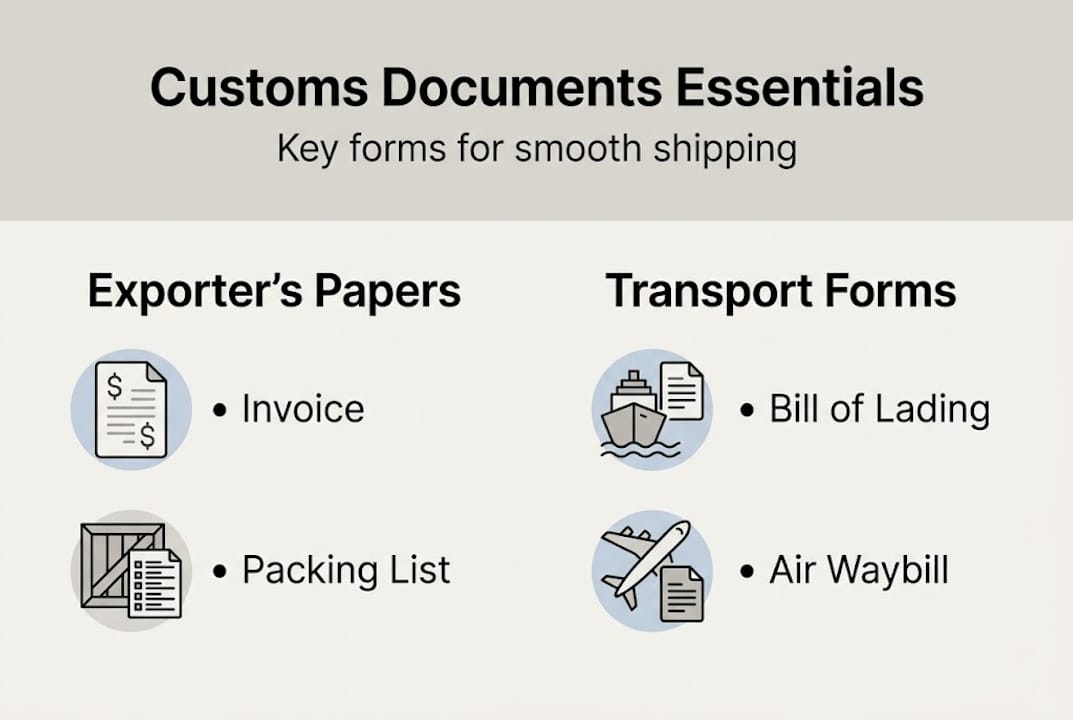
| Document | Prepared by | Key information fields |
|---|---|---|
| Commercial invoice | Exporter | Value, description, buyer/seller info |
| Packing list | Exporter/freight agent | Quantities, weights, dimensions |
| Bill of lading / air waybill | Carrier | Consignee, routing, cargo description |
| Certificate of origin | Exporter / chamber of commerce | Country of manufacture, HS code |
| CBP Form 7501 / import declaration | Customs broker / importer | Entry type, duties, classification |
For export shipping documentation and international freight paperwork, accuracy in every field matters. Even a minor mismatch between the commercial invoice and the packing list can trigger a customs exam. EU importers should also review EU import requirements for additional declaration standards.
Common mistakes when preparing these core forms include:
- Mismatched values between the invoice and packing list
- Vague or generic cargo descriptions instead of specific product details
- Missing or incorrect HS (Harmonized System) codes
- Omitting the seller’s or buyer’s full legal address
- Failing to include country of origin on the commercial invoice
Pro Tip: Use digital document templates pre-loaded with your standard product HS codes and buyer details. This cuts manual entry errors dramatically and speeds up preparation for repeat shipments.
Understanding US and EU-specific customs requirements
Knowing the universal paperwork, let’s see how requirements change depending on your destination or origin country. The US and EU each have distinct timelines, thresholds, and forms that can catch unprepared shippers off guard.
For US imports, CBP requires entry within 15 days of arrival using CBP Form 7533 or 3461, followed by an entry summary on CBP Form 7501 within 10 working days. Exports valued over $2,500 require an Electronic Export Information (EEI) filing via the Automated Export System. Ocean imports need an Importer Security Filing (ISF), commonly called 10+2, submitted at least 24 hours before vessel departure. Formal entries valued over $2,500 also require a customs bond.

For EU imports, EORI registration is mandatory for any business trading across EU borders. Importers must file an import declaration (IM-A), provide proof of origin such as an EUR.1 movement certificate for preferential duty rates, use correct HS and CN (Combined Nomenclature) codes, and supply VAT documentation. CN 2026 updates, effective January 1, 2026, introduce revised commodity codes that affect classification across several product categories.
| Requirement | United States | European Union |
|---|---|---|
| Registration | Importer of Record / EIN | EORI number |
| Entry form | CBP Form 7501 | IM-A import declaration |
| Pre-arrival filing | ISF (ocean, 24h before departure) | Entry summary declaration |
| Export filing | EEI via AES (over $2,500) | Export declaration |
| Origin proof | Certificate of origin | EUR.1 or statement on invoice |
| Bond/guarantee | Customs bond (formal entries) | Customs guarantee (varies) |
US-specific timeframes to track:
- File ISF at least 24 hours before vessel departure from origin port
- Submit entry documents within 15 calendar days of cargo arrival
- File entry summary within 10 working days of entry release
- Retain all records for a minimum of 5 years
For a detailed walkthrough of the ISF filing guide, Worldwide Express provides step-by-step support to keep ocean shipments on schedule. Additional CBP import rules are published directly by U.S. Customs and Border Protection.
Pro Tip: Subscribe to official update feeds from CBP and the European Commission’s Trade Directorate. Regulatory changes like CN 2026 revisions often take effect with little industry fanfare, and missing them can mean reclassification penalties.
Handling edge cases and special shipments
But what if your shipment is out of the ordinary? Let’s look at special cases that demand additional paperwork and vigilance. Standard documentation is just the baseline. Many product categories trigger additional requirements that can delay clearance if overlooked.
Per the International Trade Administration, edge case shipments require the following extra documentation:
- Perishables: Sanitary and phytosanitary certificates issued by the country of origin’s agricultural authority
- Hazardous materials: Dangerous goods declarations following IATA (air) or IMDG (sea) codes, plus proper labeling
- FDA-regulated goods: Prior Notice filing for food, drugs, and medical devices entering the US
- USDA-regulated goods: Import permits and inspection certificates for plant and animal products
- Textiles and apparel: Detailed fiber content declarations and country-of-origin labeling
- Dual-use goods: Export control licenses where goods have both civilian and military applications
Forced labor compliance is now a major enforcement priority. The Uyghur Forced Labor Prevention Act (UFLPA) creates a rebuttable presumption that goods from certain regions of China are made with forced labor. Importers must provide clear and convincing evidence of supply chain integrity to overcome this presumption. Documentation here includes supplier audits, production records, and shipping chain traceability reports.
Penalty alert: Missing or incorrect special certificates for regulated goods can result in cargo holds, mandatory re-export at the importer’s expense, fines up to $10,000 per violation, and in serious cases, criminal referral. The cost of getting it wrong far exceeds the cost of getting it right.
For low-value postal shipments entering the EU, CN22 forms apply to packages under 300 Special Drawing Rights (SDR), while CN23 forms cover packages up to 2,000 SDR. In the US, the de minimis threshold sits at $800, meaning shipments below this value often clear without formal entry. However, scrutiny on de minimis imports is rising sharply in 2026, particularly for goods subject to Section 301 tariffs. For guidance on perishable customs docs and regulated goods, detailed resources are available. Additional customs edge case guidance covers evolving enforcement priorities.
Solving common mistakes and speeding up customs processes
Even after assembling your documents, pitfalls can creep in. Here’s how to avoid and correct critical errors. The most damaging mistakes are often the most preventable ones.
Documentation errors cause 20 to 40% of all shipment holdups globally, and the average global export clearance time runs 8 to 11 days per World Bank data. Pre-arrival processing (PAP) programs reduce clearance time by 43%, making early and accurate filing one of the highest-return investments a shipper can make.
The most common customs paperwork errors to watch for:
- Wrong HS codes: The single biggest cause of delays. Always verify codes against the current tariff schedule before filing.
- Undervalued or misdescribed goods: Customs authorities compare declared values against market benchmarks. Discrepancies trigger audits.
- Missing signatures or certifications: An unsigned commercial invoice or certificate of origin is legally invalid.
- Incoterms misuse: Using the wrong Incoterms (trade terms defining who pays for shipping and insurance) shifts liability incorrectly and confuses customs valuation.
- Late ISF filing: For ocean shipments, a late ISF results in an automatic $5,000 penalty per violation.
Steps to fix errors once detected:
- Contact your customs broker immediately upon discovering a discrepancy
- File a post-entry amendment (CBP Form 7501 correction) before CBP initiates a formal inquiry
- Gather supporting documents such as supplier invoices, production records, or lab reports
- Submit a prior disclosure if the error involves underpaid duties, which reduces penalties significantly
- Update internal templates and checklists to prevent recurrence
Digital customs management platforms and AI-assisted HS code classification tools are changing the game. Brokers using these tools report dramatically fewer classification errors and faster document turnaround. To avoid customs delays, prevent customs penalties, and explore digital customs solutions, proactive investment in technology and expert support pays measurable dividends.
Why mastering customs documentation is a supply chain superpower
Throughout this guide, the focus has been on compliance. But there’s a bigger picture worth examining. Customs expertise is not just a defensive tool. It’s an offensive one.
BCG research shows that companies embedding customs directly into supply chain design can optimize product origin strategies, reduce total landed costs, and use AI-powered classification tools that achieve 85% accuracy in HS code assignment. That kind of precision, applied consistently, translates into real competitive advantage, not just avoided penalties.
The companies that treat customs as a back-office afterthought are the ones paying avoidable duties and watching competitors land goods faster and cheaper. The ones that centralize customs records, invest in classification technology, and integrate compliance into procurement decisions operate with a structural cost advantage that compounds over time.
For customs compliance tips and customs best practices, the resources are available. The question is whether your organization treats documentation as a burden or as a lever.
Take the stress out of customs compliance
Ready to simplify your customs process? Here’s how to move from paperwork stress to compliance confidence.
Navigating customs documentation across multiple markets, product categories, and regulatory updates is genuinely complex. Partnering with an experienced logistics provider means your documentation is prepared accurately, filed on time, and reviewed against current regulations before your cargo ever reaches the border.
Worldwide Express offers US customs brokerage services backed by deep regulatory expertise, along with a full freight forwarding guide to help you understand every step of the process. Discover how customs broker benefits translate directly into faster clearance, lower risk, and stronger supply chain performance for your business.
Frequently asked questions
What are the must-have documents for customs clearance?
Core customs documentation includes a commercial invoice, packing list, bill of lading or air waybill, certificate of origin when required, and country-specific entry forms such as CBP Form 7501 for US imports or an IM-A declaration for EU entries.
How long should customs records be kept?
Both US and EU regulations require record retention for 4 to 5 years, covering all entry documents, invoices, and correspondence related to each shipment in case of audits or disputes.
When do I need a customs broker?
A customs broker is strongly recommended for regulated goods, high-value formal entries, or any shipment where classification or valuation complexity is high. Per CBP guidance, importers retain legal responsibility even when using a broker, so choosing a qualified one matters.
What’s the number one mistake in customs paperwork?
Incorrect or missing HS codes are the most common error, responsible for up to 40% of shipment delays. Always verify codes against the current official tariff schedule before submitting any entry.
Recommended
- Streamline airport customs clearance for faster shipping – Worldwide Express, Inc.
- How to Avoid Customs Delays for Smooth International Shipping – Worldwide Express, Inc.
- Master customs compliance tips for smoother shipping – Worldwide Express, Inc.
- Master Export Shipping Documentation for Success – Worldwide Express, Inc.
- Guide to relocation logistics: smooth and stress-free moves