The fastest way to locate an international commercial shipment is to enter the correct freight reference, an AWB, B/L, booking number, HBL/house number, or container/pro number, into the system built to read it. Get the number type right first, and the portal search almost always follows.
Try this immediately:
- Master B/L number → carrier’s own tracking portal
- Booking number → forwarder portal (often not accepted by the carrier directly)
- AWB number → airline or forwarder cargo tracking system
- Container number → terminal/port tracking tool or carrier site
- Vessel/voyage → AIS-based vessel tracking for gaps between milestones
If a search returns nothing: confirm you have the right number type, strip or add letter prefixes and leading zeros, then try the container number or vessel and voyage combination instead.
Pro Tip: Carrier portals are picky about formatting. A B/L number with a hyphen, extra space, or missing prefix letter will often fail even though the shipment itself is tracking normally.
Key Takeaways
Locating an international shipment starts with matching the correct freight reference number to the system built to read it, not with searching harder in the wrong portal.
| Point | Details |
|---|---|
| Match number to portal | Use the master B/L in carrier portals, the booking or house number in forwarder portals. |
| Container number is the reliable fallback | Switch to the container number when a B/L or booking search returns no result. |
| Use vessel and voyage for gaps | AIS-based vessel tracking fills visibility gaps between official carrier milestones. |
| Fix documentation before escalating | Align names, weights, and descriptions across invoice, packing list, and B/L to prevent mismatches. |
| Escalate with full documentation | Worldwide Express resolves master B/L and container mismatches directly when you provide the full document set. |
Table of Contents
- Which order numbers exist in international freight and where do they work?
- Where do you find the order number on shipping documents?
- What is the exact workflow for tracking a shipment with an order number?
- What do tracking statuses mean, and how long should each stage take?
- Why does a tracking number return no results, and how do you fix it?
- When should you escalate to your freight forwarder, and what should you send?
- A forwarder’s take on keeping shipments trackable
- Get direct tracking support from Worldwide Express
- Frequently asked questions
- Sources
Which order numbers exist in international freight and where do they work?
Freight forwarding uses a stack of reference numbers, and each one belongs to a specific system. Knowing which is which saves you from searching a portal that was never built to read your number.
- Master Bill of Lading (MBL) / B/L number: issued by the ocean carrier; enter this directly into the carrier’s own tracking portal for the most reliable milestone updates.
- House Bill of Lading (HBL) or HAWB: issued by your forwarder; works in the forwarder’s portal but typically fails in the carrier’s system.
- Booking number: assigned when the shipment is booked with the carrier; useful for confirming space and schedule, but not always accepted for tracking searches.
- Airway Bill (AWB) number: the non-negotiable reference document for air cargo, tracked through the airline’s or forwarder’s cargo system, per how airway bills function.
- Container number and seal number: printed on the container itself, and the most durable fallback when a B/L number search stalls.
- Pro number / carrier internal reference: mainly used for trucking legs and inland moves.
The most common mistake is plugging a booking number into a carrier’s B/L search field, or a house number into a system that only recognizes the master. When in doubt, start with the number tied most directly to the carrier.
Where do you find the order number on shipping documents?
Every reference number lives on a specific document, usually in a labeled field near the top or header block. Check these first:
- Booking confirmation: look for “Booking Reference” or “Booking No.”
- Master or house bill of lading: labeled “B/L No.” or “HBL No.,” typically near the shipper/consignee block.
- Airway bill: labeled “AWB No.,” formatted as a three-digit airline prefix followed by an eight-digit serial number (the 3-8-8 pattern airlines use worldwide).
- Shipping instructions (SI): contains the booking number and cargo details submitted to the carrier.
- Commercial invoice and packing list: sometimes carry the booking or container number as a cross-reference, useful for verifying consistency.
- Carrier cargo notices and forwarder emails: often post the number in the subject line or an early paragraph of the notification.
Container numbers follow a recognizable structure too: four letters (owner code) followed by seven digits. Spotting that pattern instantly tells you what kind of number you’re holding, even if the document label is unclear.
What is the exact workflow for tracking a shipment with an order number?
Run the search in a deliberate order, starting with the number most likely to be recognized by the carrier and working outward to fallbacks.
- Confirm the number type and format. Check for letter prefixes, spacing, and leading zeros before you search anything.
- Start with your forwarder’s portal. This accepts house numbers, booking references, and usually pulls in carrier-level milestones automatically.
- Move to the carrier’s own portal using the master B/L number for ocean freight or the AWB number for air freight, since most carriers build their web tracking around the B/L number.
- Try container-level tracking on the terminal or port system if the B/L search stalls, especially useful once cargo has been discharged.
- Use vessel name and voyage number for AIS tracking to fill gaps between carrier milestone updates, a detail buried on the B/L that most shippers never think to use.
- Check customs or port release systems if the shipment shows as discharged but the status hasn’t changed for several days.
If a search returns nothing at any step, try the number both with and without its prefix letters, then substitute the container number if you have it. A wrong reference type, not a lost shipment, is the more common explanation for a blank search result.
Pro Tip: A house B/L will rarely work in a carrier’s official portal because carriers only recognize the master B/L they issued themselves. If your only document is the HBL, ask your freight forwarding contact for the master B/L number or the container number directly.

Forwarders coordinate bookings, align documentation, and manage the communication layer between you and the carrier network, which is exactly why they can pull a master B/L number faster than you can search for one, according to Coreties’s guide to international freight shipping.
What do tracking statuses mean, and how long should each stage take?
Status messages describe a milestone, not a guarantee of timing, and ocean and air freight run on very different clocks.
- Received at origin: cargo is at the forwarder’s or carrier’s facility, pre-loading.
- Loaded on vessel/aircraft: physically on board; for ocean freight this starts the voyage clock, for air freight it usually means departure within hours.
- Departed origin / In transit: moving toward destination, whether by sea or air.
- Arrived at port/airport: physically landed, but not yet released.
- Discharged: offloaded from the vessel or aircraft, awaiting terminal handling.
- On-hold for customs: an exception status requiring documentation review, distinct from “cleared for export,” which signals no issue.
- Available for pickup: cleared and ready for final delivery.
Ocean freight timelines run from booking through loading, the voyage itself, and discharge, often stretching weeks depending on the route and any transshipment stops. Air freight compresses that into check-in, airlift, and arrival, usually within days. Vessel schedule changes and customs holds are the two most common sources of delay in either mode. Between milestone updates, use the vessel name plus voyage number, or the flight number, for continuous visibility rather than waiting for the next portal refresh.
Why does a tracking number return no results, and how do you fix it?
Most “shipment not found” errors trace back to one of a handful of causes, and nearly all of them are fixable without contacting anyone.
- Wrong number type entered. A booking number typed into a B/L search field, or a house number entered where the carrier expects a master.
- Formatting mismatch. Missing prefix letters, extra spaces, or dropped leading zeros can cause an exact match search to fail.
- Transshipment or vessel change. Cargo transferred to a different vessel mid-route can create a temporary tracking gap until the new leg posts.
- Delayed carrier data posting. Some carriers update tracking systems on a batch schedule, not in real time.
- Documentation mismatches. Differences in cargo description, weight, or party names across the invoice, packing list, and B/L are a leading cause of both tracking mismatches and customs clearance delays.
Run this documentation-consistency checklist before escalating anything:
- Confirm shipper and consignee names match exactly across every document.
- Verify weights and cargo descriptions align between the commercial invoice, packing list, and B/L.
- Check that the container number on the B/L matches the number physically on the container.
If everything checks out and the search still fails, escalate: ask your forwarder to confirm the master B/L, request the container number directly, or ask the carrier to validate the exact B/L format their system expects.
Pro Tip: When in doubt, the single fastest fix is switching your search to the container number. It’s the one reference that stays constant regardless of which B/L, booking, or house number confusion caused the original mismatch.
When should you escalate to your freight forwarder, and what should you send?
Escalate once you’ve run the primary checks above and still have no result, or if you’re seeing conflicting statuses, a customs hold, or a missing master B/L with a deadline approaching.
Include these fields in your escalation request:
- The exact reference number you searched, plus the number type.
- Screenshots or timestamps of the failed portal search.
- Copies of the booking confirmation, HBL/MBL, packing list, and commercial invoice.
- Any carrier emails referencing the shipment.
- Your preferred contact method and the outcome you need (confirmation, release, updated ETA).
Ask for a triage response within a few hours and a full research update within 24 to 48 hours, depending on the mode and route complexity. A forwarder with the full document set in hand rarely needs a second round of questions to move forward.
A forwarder’s take on keeping shipments trackable
Most “lost” shipments aren’t lost. They’re mismatched, someone searched a booking number in a system built for a master B/L, or a party name on the invoice doesn’t quite match the B/L. Forwarders spend a disproportionate amount of triage time reconciling documents rather than chasing carriers.
The fix starts upstream: standardize how you name shippers and consignees across every document, write commodity descriptions the same way every time, and share container and seal numbers with your forwarder as soon as they’re issued, not after a tracking problem surfaces. And treat your order numbers with the same discretion as any other shipment document. Third-party tracking apps and portals should only ever see the reference number itself, never full commercial invoices or banking details.
Get direct tracking support from Worldwide Express
Chasing down a mismatched B/L number or a house bill that won’t load in a carrier’s portal costs time you don’t have when a release date is on the line. Worldwide Express handles that reconciliation work directly, cross-checking your booking confirmation, master B/L, and container data so you’re not stuck guessing which reference goes where.
For ocean shipments specifically, the ocean freight forwarding process walks through exactly how container assignments, B/L numbers, and vessel schedules connect from booking to discharge. If your shipment is sitting in a customs hold rather than a tracking gap, U.S. customs brokerage support is built to resolve exactly that kind of exception. Request a freight quote or ask for a tracking check on your current shipment to get a forwarder looking at your documents today.
Frequently asked questions
How can I track my parcel if I only have a booking number?
Try your forwarder’s portal first, since booking numbers are usually recognized there even when the carrier’s own system rejects them. If that fails, ask your forwarder for the master B/L or container number.
How do you track an order that shows no updates for several days?
Check whether the status is “discharged” rather than “in transit.” A gap after discharge often means the cargo is sitting at the terminal awaiting customs clearance, not that it’s lost.
How do I find order details when the document only lists an HBL number?
The house number confirms your booking with the forwarder but won’t work in a carrier’s public tracking tool. Request the corresponding master B/L or container number for carrier-level visibility.
What’s the difference between order number tracking using a booking number versus a container number?
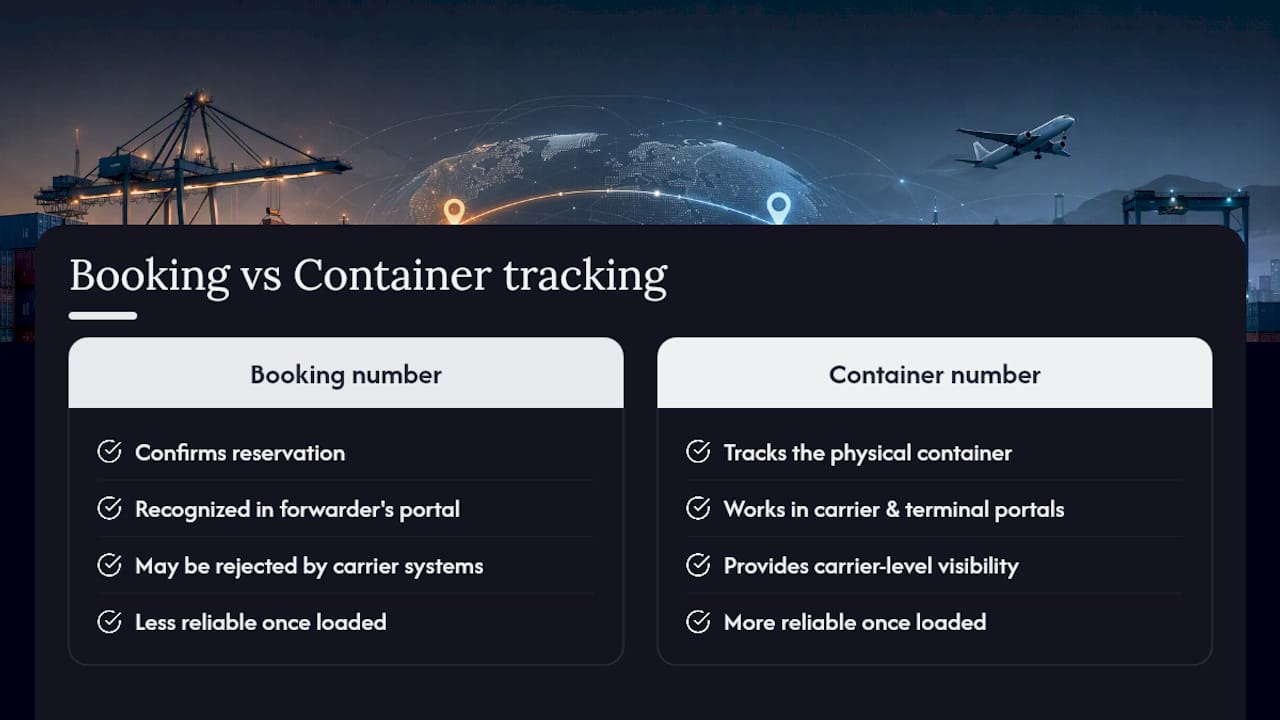
A booking number confirms the shipment was reserved with the carrier; a container number tracks the physical box. Once cargo is loaded, the container number is usually the more reliable search term.
Can I check order status online without contacting my forwarder?
Yes, for most milestones. Carrier portals, terminal tracking tools, and AIS vessel tracking cover the bulk of the shipment lifecycle. Contact your forwarder only when results conflict or a hold appears.
Sources
- Guide to International Frieght Shipping: 2026 Expert Advice | Coreties Blog
- Bill of Lading: What It Is and How to Track Your Cargo – Primo Nautic